Snix Sole Designer 2024

Designing trust into a system that broke it

Role

Sole Product Designer

Platform

iOS · App Store

Timeline

0 to 1 · Shipped September 2021

Year

2021

Status

Live on App Store

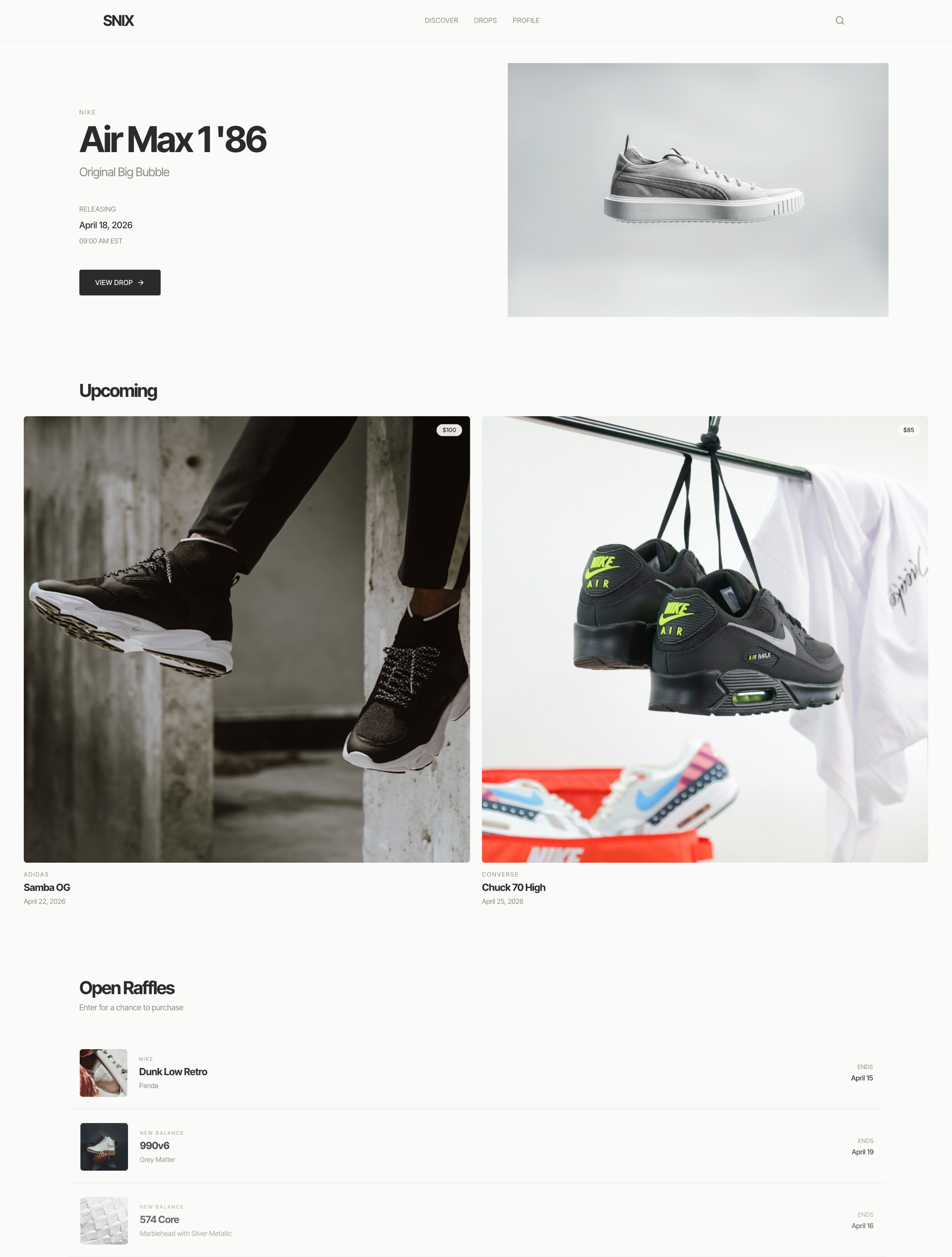
Snix full product system: discovery, upcoming releases, and open raffles
Role:Product Designer Team:Founder + engineering Timeline:2021 launch Platform:iOS App Store Scope:UX strategy, raffle flow, UI, prototyping, design QA

Limited sneaker releases are one of the most emotionally charged purchasing experiences in consumer retail. Demand massively outstrips supply. The window to enter is minutes long. And for most real users, the outcome is always the same: they lose.

That loss is tolerable. What isn't tolerable is not understanding why.

Across platforms like SNKRS, GOAT, and StockX, the experience is structurally broken in three specific ways. Bots dominate entry windows before real users have a chance. Raffle outcomes are announced with zero explanation: no context, no entry count, no selection logic. And after repeated failure, users disengage entirely, not because they stopped wanting the product, but because the system stopped feeling worth engaging with.

My job wasn't to solve scarcity. It was to design a system where losing felt fair, and where users wanted to come back anyway.

Lack of transparency erodes trust faster than losing does

Users couldn't explain how winners were selected. The absence of information felt like evidence of manipulation, not a neutral silence.

Perceived bot dominance discourages participation before it starts

Users had developed a prior belief that bots had already won before they entered. That belief made entry feel pointless, reducing both completion rate and emotional investment.

Repeated failure without explanation leads to permanent disengagement

Users didn't stop trying because they lost. They stopped because they had no reason to believe the next attempt would be different.
I conducted competitive analysis across SNKRS, GOAT, and StockX, ran one on one interviews with sneaker enthusiasts, and ran task based walkthroughs of existing drop flows. The research validated the three core problems users faced: the complete lack of transparency around selection logic, the perception of bot dominance before entry, and the spiral of disengagement after repeated failures with no explanation.

The visible problem was trust. Users entered drops and the experience went silent, no confirmation, no fairness signal, no sense of what came next. But that silence pointed to something deeper. Sneaker releases were scattered across SNKRS, Adidas Confirmed, Foot Locker, GOAT, StockX, and dozens of boutiques. No single product owned the path from finding a drop to learning the result. The broken trust was a symptom. The root cause was fragmentation.

So the real decision was about what Snix should be.

The obvious direction was a traditional sneaker storefront: product browsing, detail pages, checkout at the center. Familiar, but it solved the wrong problem. Limited drops do not behave like normal ecommerce. Users were not short on places to shop. They were short on a place that could show them where raffles were available, get them entered before deadlines, track their status, and tell them what happened after selection.

I rejected the storefront model because it would have made Snix one more place to buy sneakers. The stronger direction was to treat Snix as a raffle coordination layer across platforms, the single place that owned the full arc from discovery to result.

That reframe is what made trust solvable. Once Snix owned the whole journey, the transparency layer, the verified entry confirmation, the plain language outcome, had somewhere to live. You cannot design trust into a moment you do not own. The coordination decision is what gave the trust work a home.

Rejected

A traditional sneaker storefront centered on browsing and checkout.

It solved the wrong problem. Users struggled with fragmented raffle access, not a shortage of stores.

Chosen

A multi-platform raffle layer for discovering, entering, tracking, and resolving drops.

It reframed Snix from a commerce interface into a trust and coordination system.

Reducing entry friction

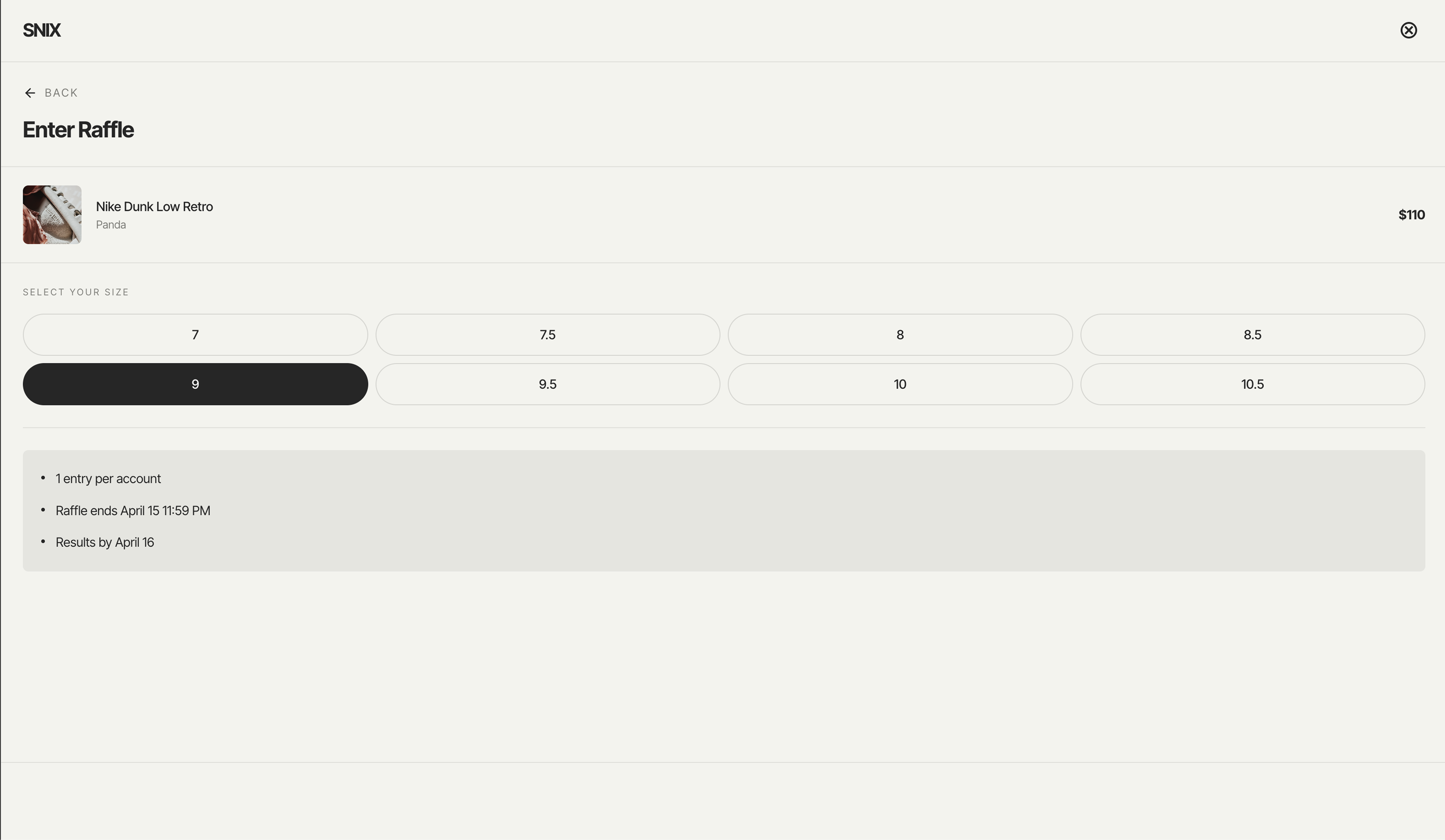
The original entry flow required five steps and averaged 18 seconds to complete. I stripped it to two steps, size selection and confirmation, reducing completion time to approximately 7 seconds. Fewer inputs meant fewer abandoned entries, and a faster flow meant users could enter with confidence during tight release windows.

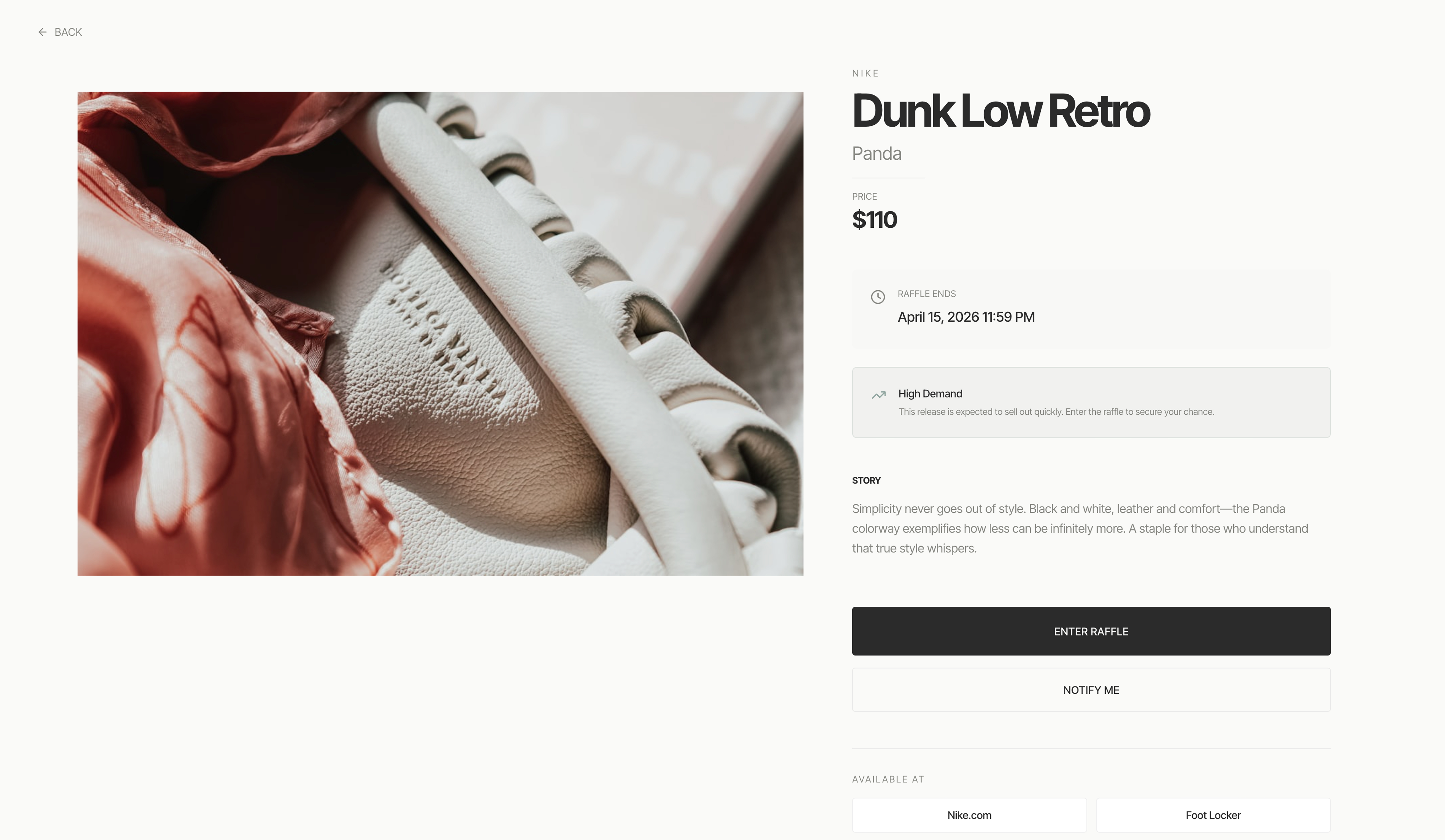
Desktop raffle detail view showing the shortened entry flow in context
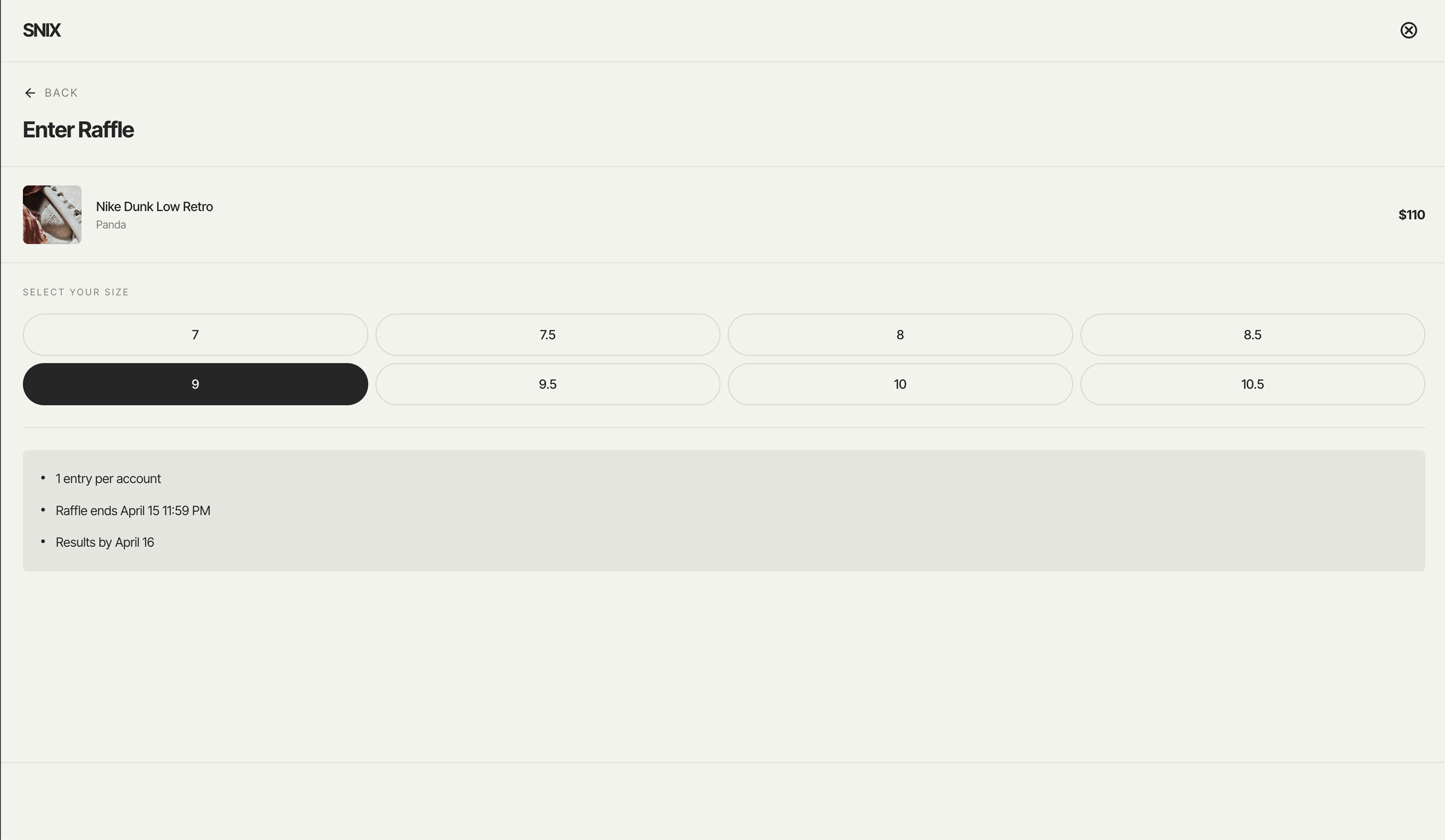
Desktop raffle size selection view showing the shortened entry flow

Anti-bot infrastructure

Timed entry windows, account verification layers, and one entry per user reduced the structural advantage bots had over real users. This came with a tradeoff, slightly increased friction for legitimate users. But the fairness gain was non-negotiable. I made that tradeoff explicitly and documented it for the team.

The transparency layer

This was the most significant innovation in the redesign. For the first time, users could see their entry confirmation, live raffle status (open, closed, selecting) and a plain language explanation of how the outcome was determined.

When a raffle closed, instead of a binary win or lose notification, users saw:

"Selected randomly from 12,482 verified entries."

That single sentence answered every question users had been asking for years. It confirmed their entry was real. It confirmed the pool was large and competitive. And it confirmed the selection was random, not rigged.

The post-raffle experience

Previously, losing a raffle was a dead end. A notification, a closed door, nothing else. The redesign turned the loss state into an active moment: recommended alternatives surfaced based on style and size, upcoming drops relevant to the user's history, and a direct path to the secondary market for that specific shoe.

Winning was equally intentional: a direct purchase flow with the user's size already selected, minimal steps to checkout, and a clear countdown on the purchase window. The win state was designed to convert, not just celebrate.

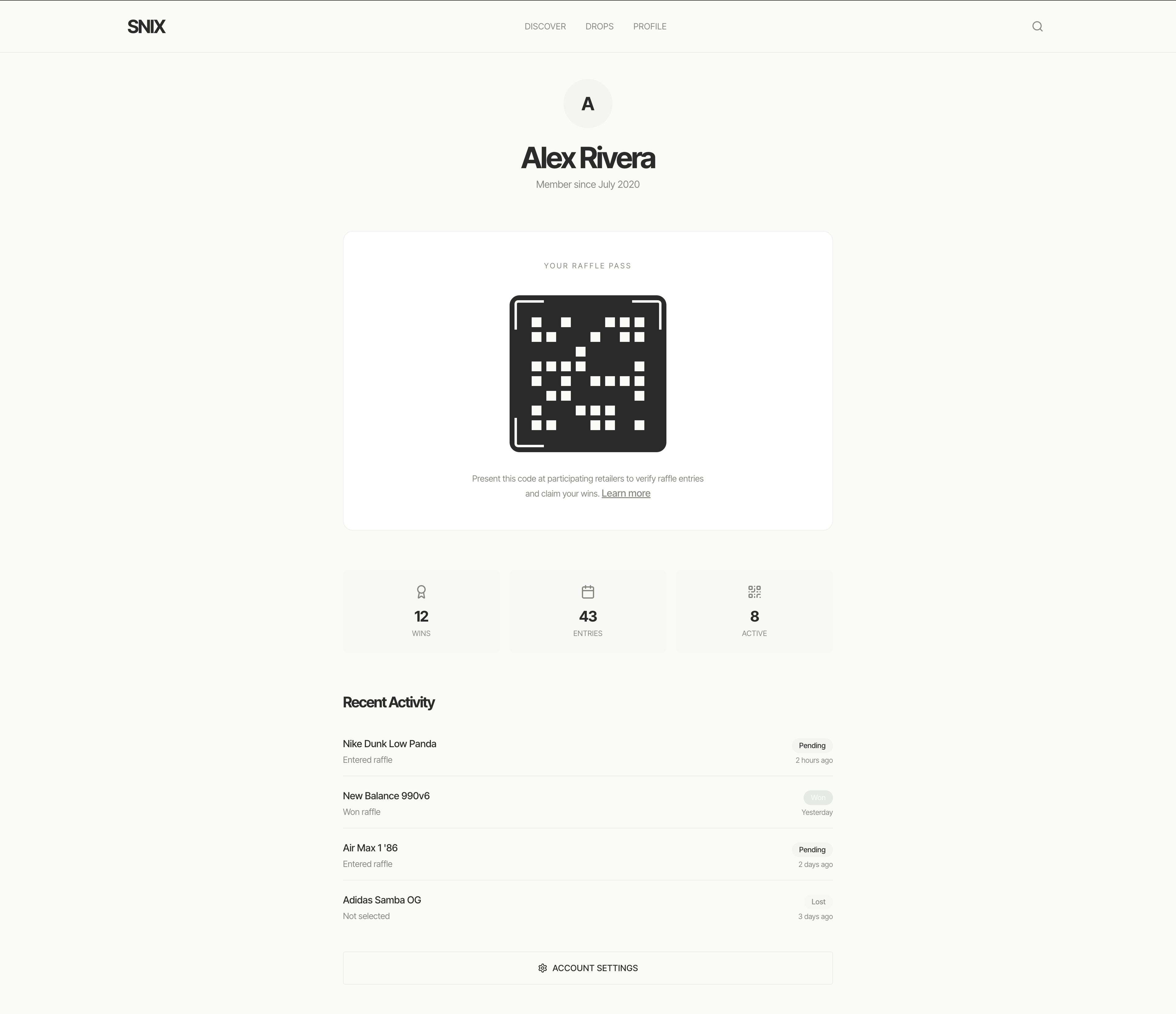
User profile showing raffle history with plain language outcomes, every entry visible, every result explained

Every meaningful design decision in this project involved a real tradeoff. I made these explicitly, not as compromises, but as intentional choices with documented reasoning.

Gained

Higher perceived fairness

Traded

No loyalty incentive for returning users

Gained

Faster entry, fewer abandoned entries

Traded

Less customization per entry

Gained

Bot resistance, real user priority

Traded

Slightly increased friction for all users

Gained

User trust through transparency

Traded

More complex system communication required

The most contested was the equal weight raffle versus a loyalty priority system. A loyalty model would reward returning users and incentivize engagement but it would also mean that users with more history had a statistically better chance of winning.

That directly contradicted the core trust argument. I chose fairness over loyalty, with full awareness that it left engagement incentives on the table.

Dunk Low Retro product detail page with raffle entry CTA
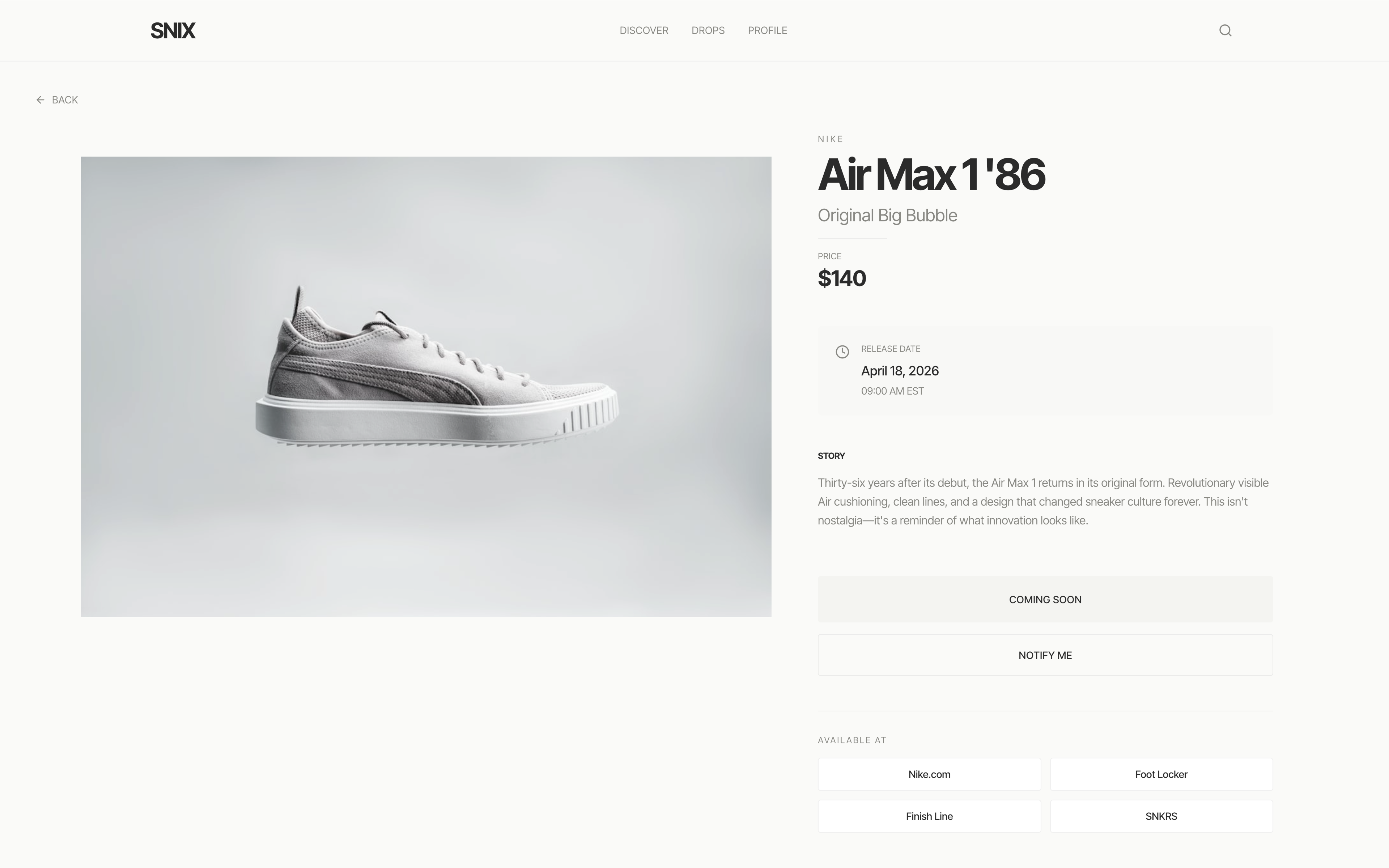
Air Max 1'86 product detail page with availability
Size selection and confirmation flow
User profile showing raffle pass and recent activity

Snix launched on the App Store in September 2021 with no paid acquisition and no marketing budget. Organic growth only. Outcomes measured through App Store Connect analytics and in-app event tracking. Usability testing conducted with 8 participants against SNKRS and GOAT as baselines.

5-step flow reduced to 2

Removed unnecessary decision points and combined repeated actions into a focused entry path.

18s to 7s entry time

Shortened average entry completion time during task testing, so users could enter drops before deadlines closed.

850 App Store downloads

Launched publicly on the App Store with early organic traction.

The trust problem was not solved with visual polish. It was solved by making the raffle process visible and verifiable. Snix showed users where raffles were available, confirmed when an entry was submitted, surfaced live raffle status, displayed the verified entry count behind each random selection, and gave clear next steps after a win or loss. The transparency layer, showing users they were selected randomly from a verified pool, directly addressed the suspicion that raffles were rigged.

After launch, App Store reviews pointed to the same themes, confidence, clarity, and visibility:

# Reviews after launch
★★★★★"I finally knew my entry actually went through instead of just hoping it did."
★★★★★"I didn't have to bounce between a bunch of apps just to figure out where I could enter."
★★★★★"Even when I lost, at least I understood what happened and what I could do next."

The measured impact was entry speed and flow simplification. The trust impact is supported qualitatively, through what users wrote about confidence, clarity, and knowing the result was fair.

★ ★ ★ ★ ★

"At least now I understand what's going on. It feels more legit."

KT

Kayla T.

★ ★ ★ ★ ★

"Seeing how many people entered makes it feel fair, even if I lose."

DJ

Devon J.

★ ★ ★ ★ ★

"I didn't win, but I didn't feel frustrated like before."

SM

Sofia M.

"Systems drive impact. Screens just make it visible."

The biggest gains in this project came from selection logic, flow architecture, and feedback loops, not visual polish. The transparency layer is a single sentence on a screen. But that sentence required designing the entire raffle system behind it: how entries are counted, how status is communicated in real time, how outcomes are explained at scale.

The second thing I learned: users tolerate loss when they understand why. Confusion is more damaging than disappointment. If you can design a system where losing still makes sense, where the user feels the outcome was legitimate and you retain them for the next drop. That's the product lever most consumer platforms are missing.

And the third: the most important design decisions aren't interface decisions. Choosing equal weight raffle over loyalty priority was a product strategy call. I made it as the designer, brought it to the team with evidence, and owned the tradeoff. That's what senior product design actually looks like.